

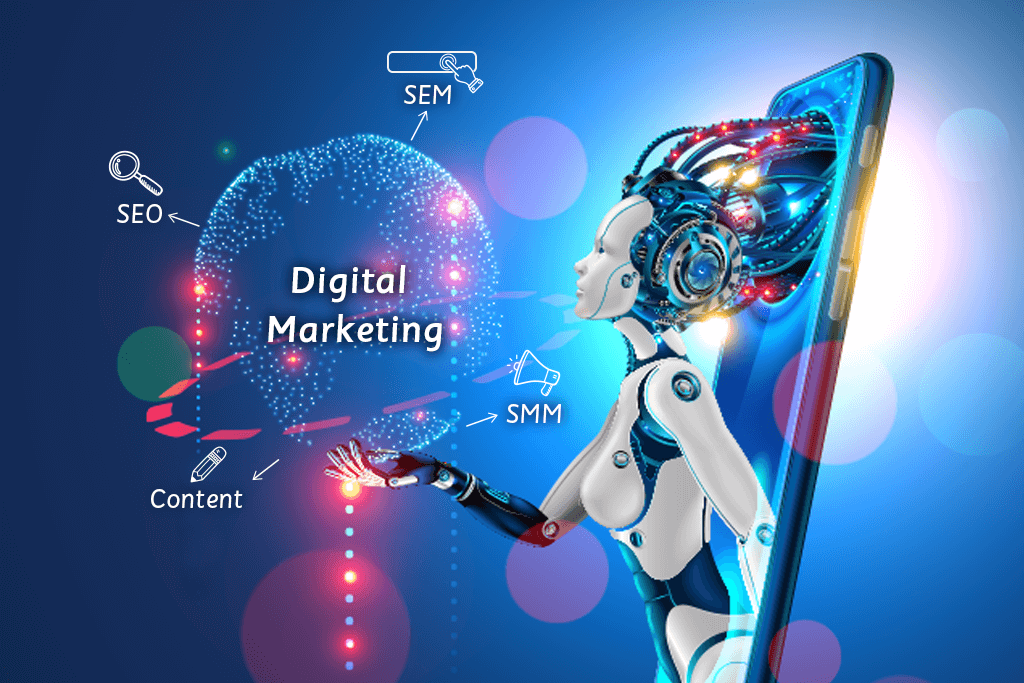
Introduction to AI in Digital Marketing
Artificial Intelligence (AI) is rapidly transforming the way businesses approach digital marketing. In simple terms, AI refers to machines and software that can analyze data, learn patterns, and make decisions with minimal human intervention. From personalized recommendations on e-commerce websites to chatbots that provide instant customer support, AI has become an integral part of modern marketing strategies.
In today’s competitive digital landscape, marketers deal with massive amounts of data every day — customer behavior, search trends, engagement metrics, and purchase patterns. AI helps process this data quickly and accurately, allowing businesses to make smarter marketing decisions. Instead of relying only on guesswork, companies can now use predictive insights to understand what customers want and when they want it.
AI-powered tools are improving content creation, SEO optimization, paid advertising, email marketing, and customer targeting. These technologies enable brands to deliver highly personalized experiences, increase engagement, and boost conversion rates. For digital marketing agencies, adopting AI is no longer optional — it has become essential to stay competitive and deliver measurable results.
As AI continues to evolve, it is not replacing marketers but empowering them. By combining human creativity with AI-driven analytics and automation, businesses can build more effective, data-driven marketing campaigns that drive long-term growth.v
AI-Powered Content Creation
Content is the backbone of digital marketing — but creating high-quality, engaging content consistently can be time-consuming and challenging. This is where Artificial Intelligence (AI) is transforming the game. AI-powered content creation tools help marketers generate blog posts, social media captions, ad copy, email campaigns, and even videos in a fraction of the time.
1️⃣ AI for Blog Writing & Copywriting
AI writing tools analyze large volumes of data to understand tone, structure, and audience preferences. They can generate SEO-optimized blog posts, product descriptions, landing page copy, and ad creatives within minutes. Marketers can use AI to create first drafts quickly and then refine them with human creativity for a more personalized touch.
2️⃣ Personalized Content at Scale
One of the biggest advantages of AI is personalization. AI systems analyze user behavior, interests, search history, and past interactions to deliver tailored content to each user. Whether it’s personalized email campaigns or dynamic website content, AI ensures the right message reaches the right audience at the right time.
3️⃣ AI in Visual & Video Content Creation
AI is not limited to text. It can generate images, design creatives, create short-form videos, and even edit video content automatically. Businesses can now produce professional-quality visuals without requiring large production teams, saving both time and cost.
4️⃣ Content Optimization & Performance Improvement
AI tools can also suggest improvements in headlines, readability, keyword placement, and engagement structure. By analyzing performance data, AI identifies what type of content performs best and recommends strategies to increase traffic and conversions.
Why AI-Powered Content Creation Matters
- Saves time and increases productivity
- Improves content consistency
- Enables data-driven creativity
- Helps scale marketing efforts faster
While AI accelerates content production, human creativity remains essential. The best results come from combining AI efficiency with human strategy, storytelling, and emotional intelligence.
AI in SEO Optimization
Search Engine Optimization (SEO) is no longer just about adding keywords to content. With search engines becoming smarter, AI is now playing a crucial role in helping businesses improve their rankings and visibility. Artificial Intelligence allows marketers to analyze vast amounts of data, understand search intent, and create content that aligns perfectly with what users are looking for.
1️⃣ Smart Keyword Research
Traditional keyword research can be time-consuming and often based on guesswork. AI-powered tools analyze search trends, competition levels, and user intent to suggest high-performing keywords. These tools also identify long-tail keywords and semantic variations that increase the chances of ranking higher on search engines.
2️⃣ AI-Based Content Optimization
AI helps optimize content by analyzing top-ranking pages and recommending improvements in structure, readability, keyword placement, and internal linking. It can suggest:
- Ideal word count
- Relevant subtopics
- Related keywords (LSI)
- Heading structure improvements
This ensures your content matches search engine algorithms and user expectations.
3️⃣ Search Intent & Predictive Analysis
Modern SEO focuses heavily on search intent. AI tools study user behavior patterns to determine whether a query is informational, transactional, or navigational. This helps businesses create content that directly answers user needs, increasing engagement and reducing bounce rates.
AI can also predict future search trends by analyzing historical data, allowing marketers to stay ahead of competitors.
4️⃣ Technical SEO Automation
AI can identify technical issues such as:
- Broken links
- Slow page speed
- Crawl errors
- Duplicate content
Automated SEO audits help businesses fix problems quickly and maintain strong website health.
Chatbots & Conversational Marketing
In today’s fast-paced digital world, customers expect instant responses. They don’t want to wait hours for an email reply or stay on hold for customer support. This is where AI-powered chatbots and conversational marketing are transforming digital marketing strategies.
Chatbots are AI-driven tools that simulate human conversations through websites, social media platforms, and messaging apps. They can answer queries, guide users, collect leads, and even process orders — all in real time.
1️⃣ 24/7 Customer Support & Instant Responses
Unlike human teams, AI chatbots work round the clock. Whether it’s midnight or a holiday, customers can get immediate answers to their questions. This improves user experience and increases customer satisfaction.
2️⃣ Lead Generation & Qualification
Chatbots don’t just answer questions — they also capture valuable data. They can:
- Collect contact details
- Ask qualifying questions
- Segment leads based on interest
- Book appointments automatically
This helps businesses generate high-quality leads without manual effort.
3️⃣ Personalized User Interaction
AI chatbots analyze user behavior, browsing history, and previous interactions to deliver personalized responses. Instead of generic replies, customers receive tailored recommendations and relevant offers, which increases engagement and conversion rates.
4️⃣ Conversational Marketing Strategy
Conversational marketing focuses on real-time, one-to-one interactions between brands and customers. Instead of pushing messages through traditional ads, businesses engage users in meaningful conversations. This approach:
- Builds trust
- Reduces friction in the buying journey
- Speeds up decision-making
Platforms like website live chat, WhatsApp, Facebook Messenger, and Instagram DMs are commonly used for conversational marketing.
Why Chatbots Are Essential in Modern Marketing
- Faster response time
- Improved customer experience
- Higher conversion rates
- Reduced operational costs
- Scalable communication
However, while AI chatbots automate conversations efficiently, human support remains important for complex queries and emotional interactions. The best strategy is a hybrid model — AI for speed and automation, humans for empathy and relationship-building.
AI in Social Media Marketing
Social media has become one of the most powerful marketing channels for businesses. However, managing multiple platforms, creating consistent content, analyzing performance, and targeting the right audience can be overwhelming. This is where Artificial Intelligence (AI) is transforming social media marketing.
AI helps businesses automate tasks, understand audience behavior, and deliver highly personalized content that increases engagement and conversions.
1️⃣ Smart Content Creation & Scheduling
AI-powered tools can suggest trending topics, generate captions, recommend hashtags, and even design creatives. They analyze engagement data to determine:
- The best time to post
- The type of content your audience prefers
- Which format performs better (reels, carousels, videos, etc.)
This ensures your content strategy is data-driven rather than guess-based.
2️⃣ Advanced Audience Targeting
AI analyzes user behavior, interests, demographics, and online activity to create highly targeted audience segments. This improves ad performance and organic reach by ensuring content is shown to people who are most likely to engage or convert.
3️⃣ Social Listening & Sentiment Analysis
AI tools monitor social media conversations in real-time. They track:
- Brand mentions
- Customer feedback
- Trending topics
- Competitor activities
Sentiment analysis helps businesses understand whether the audience reaction is positive, negative, or neutral — allowing brands to respond quickly and protect their reputation.
4️⃣ Performance Analysis & Optimization
AI evaluates campaign performance instantly by analyzing metrics like engagement rate, click-through rate (CTR), reach, and conversions. It identifies what’s working and what needs improvement, helping marketers optimize campaigns for better ROI.
Why AI is a Game-Changer for Social Media Marketing
- Saves time through automation
- Improves targeting accuracy
- Boosts engagement rates
- Enhances decision-making with real-time insights
- Increases return on ad spend (ROAS)
While AI enhances efficiency and accuracy, creativity and brand storytelling still require human input. The most successful social media strategies combine AI-powered data insights with human creativity and emotional connection.
AI in Paid Advertising (PPC)
Paid advertising (PPC) has evolved significantly with the integration of Artificial Intelligence. Earlier, marketers manually selected keywords, set bids, and optimized campaigns based on limited data. Today, AI-powered systems analyze massive datasets in real time to improve targeting, bidding, and overall campaign performance.
AI enables advertisers to reach the right audience at the right time with the right message — maximizing return on investment (ROI).
1️⃣ Smart Bidding Strategies
AI-driven platforms like Google Ads and Meta Ads Manager use machine learning to automatically adjust bids based on user behavior, device type, location, time of day, and likelihood of conversion.
Instead of manual bidding, AI optimizes for:
- Conversions
- Target CPA (Cost Per Acquisition)
- Target ROAS (Return on Ad Spend)
- Click-through rate (CTR)
This reduces wasted ad spend and improves campaign efficiency.
2️⃣ Advanced Audience Targeting & Segmentation
AI analyzes user data such as search history, browsing behavior, interests, and purchase intent. It creates detailed audience segments and even predicts which users are most likely to convert.
Features like:
- Lookalike audiences
- Retargeting automation
- Intent-based targeting
allow businesses to focus on high-value prospects.
3️⃣ Dynamic Ad Creation & Personalization
AI can automatically generate multiple ad variations and test them simultaneously (A/B testing). It identifies the best-performing headlines, descriptions, and creatives, then shifts budget toward the highest-converting versions.
Dynamic ads personalize messaging based on user preferences — showing relevant products or services that users previously viewed.
4️⃣ Real-Time Performance Optimization
AI continuously monitors campaign metrics such as:
- CPC (Cost Per Click)
- Conversion rate
- Quality Score
- Engagement metrics
It makes instant adjustments to improve results without waiting for manual intervention.
Why AI is Transforming PPC Advertising
- Improved targeting accuracy
- Better conversion rates
- Reduced ad spend wastage
- Faster campaign optimization
- Higher ROI & ROAS
However, while AI handles automation and data analysis, human strategy remains critical. Campaign goals, creative direction, messaging, and brand positioning still require expert input. The most successful PPC campaigns combine AI automation with strategic marketing expertise.
AI for Data Analytics & Customer Insights
In digital marketing, data is everything. Every click, search, purchase, and interaction generates valuable information. However, manually analyzing massive datasets is nearly impossible. This is where Artificial Intelligence (AI) plays a transformative role.
AI-powered data analytics tools process large volumes of structured and unstructured data in seconds, helping businesses uncover meaningful patterns, predict customer behavior, and make smarter marketing decisions.
1️⃣ Predictive Analytics for Smarter Decisions
AI uses historical data and machine learning algorithms to forecast future trends. It can predict:
- Which customers are likely to convert
- When customers may stop engaging (churn prediction)
- Future sales patterns
- Seasonal demand fluctuations
This allows businesses to create proactive marketing strategies instead of reactive ones.
2️⃣ Deep Customer Behavior Analysis
AI tracks user behavior across websites, social media, emails, and ads. It analyzes:
- Browsing history
- Purchase patterns
- Time spent on pages
- Engagement levels
By understanding customer journeys, marketers can optimize touchpoints and deliver personalized experiences that increase conversion rates.
3️⃣ Customer Segmentation & Personalization
AI automatically groups customers into meaningful segments based on demographics, interests, and behavior. This enables:
- Targeted email campaigns
- Personalized ad creatives
- Customized website content
- Product recommendations
The result? Higher engagement, improved customer satisfaction, and better ROI.
4️⃣ Real-Time Data Processing & Insights
Traditional reporting often relies on weekly or monthly data analysis. AI provides real-time insights, allowing marketers to adjust campaigns instantly based on performance metrics.
Tools like Google Analytics use AI-driven insights to highlight trends, anomalies, and opportunities automatically.
Why AI-Driven Analytics is Essential
- Faster data processing
- Accurate forecasting
- Improved personalization
- Higher marketing ROI
- Better customer retention
AI doesn’t just collect data — it transforms data into actionable insights. When combined with human strategy and creativity, AI-powered analytics becomes a powerful engine for business growth.
Email Marketing Automation with AI
Email marketing remains one of the highest ROI digital marketing channels. However, sending generic emails to an entire subscriber list no longer delivers strong results. Modern customers expect personalization, relevance, and timely communication. This is where Artificial Intelligence (AI) transforms email marketing automation.
AI helps businesses create smarter, data-driven email campaigns that increase open rates, engagement, and conversions — all with minimal manual effort.
1️⃣ Personalized Email Campaigns at Scale
AI analyzes subscriber data such as:
- Browsing history
- Past purchases
- Email engagement
- Demographics and interests
Based on this data, AI automatically segments audiences and sends personalized emails tailored to individual preferences. Instead of one message for all, each subscriber receives relevant content, product recommendations, and offers.
2️⃣ Smart Subject Line Optimization
Subject lines determine whether an email gets opened or ignored. AI tools analyze past campaign performance to suggest high-converting subject lines. They test variations and predict which version is most likely to increase open rates.
This reduces guesswork and improves campaign performance significantly.
3️⃣ Best Time & Frequency Optimization
AI determines the best time to send emails to each subscriber by analyzing engagement patterns. Some users may open emails in the morning, while others engage late at night.
AI ensures emails are delivered when recipients are most likely to open them, increasing click-through rates (CTR).
4️⃣ Automated Customer Journeys
AI enables automated email sequences based on user behavior, such as:
- Welcome email series
- Abandoned cart reminders
- Post-purchase follow-ups
- Re-engagement campaigns
Platforms like Mailchimp and HubSpot use AI-driven automation to trigger emails at the right stage of the customer journey.
5️⃣ Performance Prediction & Continuous Optimization
AI monitors key metrics like:
- Open rate
- Click-through rate
- Conversion rate
- Unsubscribe rate
It identifies patterns and automatically optimizes future campaigns for better ROI.
Why AI is Revolutionizing Email Marketing
- Higher personalization
- Improved engagement rates
- Better lead nurturing
- Increased conversions
- Reduced manual workload
While AI enhances automation and accuracy, strong copywriting and brand voice still require human creativity. The best email marketing strategies combine AI insights with compelling storytelling.
Benefits of AI in Digital Marketing
Artificial Intelligence is not just a trend — it has become a powerful competitive advantage for businesses. From automation to personalization, AI helps marketers make smarter decisions, improve efficiency, and deliver better results. Here are the key benefits of AI in digital marketing:
1️⃣ Improved Personalization
AI analyzes customer data such as browsing behavior, purchase history, and engagement patterns to deliver personalized content, product recommendations, and offers.
Personalization increases:
- Customer satisfaction
- Engagement rates
- Conversion rates
- Brand loyalty
Modern consumers expect relevant experiences, and AI makes large-scale personalization possible.
2️⃣ Better Decision-Making with Data
AI processes massive datasets in real time and converts them into actionable insights. Instead of relying on guesswork, marketers can make data-driven decisions backed by predictive analytics and performance forecasting.
This leads to:
- Smarter campaign strategies
- Better audience targeting
- Higher marketing ROI
3️⃣ Increased Efficiency & Time Savings
AI automates repetitive tasks such as:
- Email scheduling
- Ad bidding
- Content optimization
- Reporting and analytics
Automation reduces manual workload, allowing marketing teams to focus on strategy and creativity.
4️⃣ Higher Conversion Rates
AI improves targeting accuracy by identifying high-intent users. It ensures that ads, emails, and content reach people who are most likely to convert.
This means:
- Reduced wasted ad spend
- Improved Cost Per Acquisition (CPA)
- Higher Return on Ad Spend (ROAS)
5️⃣ Enhanced Customer Experience
With AI-powered chatbots, personalized recommendations, and real-time support, businesses can offer seamless customer experiences. Faster responses and relevant communication build trust and improve customer retention.
6️⃣ Predictive Marketing & Future Forecasting
AI doesn’t just analyze past data — it predicts future trends. Businesses can anticipate customer needs, seasonal demand, and market shifts before competitors, gaining a strategic advantage.
7️⃣ Scalability
AI allows businesses to scale marketing efforts without significantly increasing resources. Campaigns can run across multiple channels efficiently while maintaining performance consistency.
Why Businesses Must Adopt AI Now
Companies that leverage AI in digital marketing gain a significant edge in efficiency, targeting, and performance optimization. While human creativity and strategy remain essential, AI enhances execution and accelerates growth.
In today’s competitive digital landscape, adopting AI is no longer optional — it’s essential for sustainable success.
Challenges & Limitations of AI in Marketing
While Artificial Intelligence offers powerful advantages in digital marketing, it is not without challenges. Businesses must understand its limitations to use AI effectively and responsibly. Over-reliance on automation without proper strategy can lead to missed opportunities and potential risks.
Here are the key challenges and limitations of AI in marketing:
1️⃣ Data Privacy & Security Concerns
AI systems rely heavily on customer data to function effectively. However, collecting and analyzing large volumes of personal data raises privacy concerns. Strict data protection regulations (such as GDPR and other regional laws) require businesses to handle customer information responsibly.
Failure to maintain data security can result in:
- Legal penalties
- Loss of customer trust
- Brand reputation damage
2️⃣ High Implementation Costs
Advanced AI tools and platforms can be expensive, especially for small and medium-sized businesses. Costs may include:
- Software subscriptions
- Integration with existing systems
- Training staff
- Ongoing maintenance
Although AI delivers long-term ROI, the initial investment can be challenging for some companies.
3️⃣ Lack of Human Creativity & Emotional Intelligence
AI can analyze data and automate tasks, but it lacks human creativity, empathy, and emotional understanding. Marketing often requires storytelling, brand voice consistency, and emotional connection — areas where human expertise remains essential.
Over-automation can make communication feel robotic or impersonal.
4️⃣ Data Quality Dependency
AI is only as good as the data it receives. Poor-quality, incomplete, or biased data can lead to inaccurate insights and wrong marketing decisions. If data inputs are flawed, AI-generated outputs will also be unreliable.
5️⃣ Over-Reliance on Automation
While automation improves efficiency, relying too heavily on AI can reduce strategic thinking. Businesses still need:
- Human oversight
- Campaign monitoring
- Strategic planning
- Creative direction
AI should support marketing teams, not replace them.
6️⃣ Technical Complexity & Skill Gap
Implementing AI tools requires technical knowledge and data analysis skills. Many organizations face a skill gap when it comes to managing AI-driven platforms effectively.
Without proper training, businesses may not fully utilize AI’s potential.
The Balanced Approach
AI is a powerful tool, but it works best when combined with human expertise. A balanced approach — where AI handles automation and data analysis while humans focus on creativity and strategy — delivers the best results.
Understanding both the strengths and limitations of AI ensures businesses can leverage it responsibly and effectively for long-term growth.
Future of AI in Digital Marketing
Artificial Intelligence is not just reshaping digital marketing — it is redefining its future. As technology continues to evolve, AI will become more intelligent, predictive, and deeply integrated into every aspect of marketing strategy. Businesses that adapt early will gain a significant competitive advantage.
Here’s what the future of AI in digital marketing looks like:
1️⃣ Hyper-Personalization at Scale
In the future, AI will go beyond basic personalization. Instead of segment-based targeting, brands will deliver individual-level experiences.
Websites, emails, ads, and even product recommendations will adapt in real time based on user behavior, preferences, and intent. Customers will expect brands to understand their needs instantly — and AI will make this possible.
2️⃣ Advanced Predictive Marketing
AI will increasingly predict customer behavior before it happens. Marketers will be able to:
- Identify high-value customers early
- Predict purchase intent
- Forecast churn risk
- Anticipate market trends
This shift from reactive to predictive marketing will help businesses stay ahead of competitors.
3️⃣ Voice Search & AI Assistants
With the rise of smart assistants like Google Assistant, Amazon Alexa, and Apple Siri, voice search optimization will become increasingly important.
Marketers will need to optimize content for conversational queries and natural language searches, as voice-based interactions continue to grow.
4️⃣ AI-Driven Marketing Automation Ecosystems
Future marketing systems will be fully automated and interconnected. AI will manage:
- Ad placements
- Budget allocation
- Content personalization
- Customer journeys
- Real-time campaign optimization
This will create seamless, data-driven marketing ecosystems that operate with minimal manual intervention.
5️⃣ AI-Generated Creative Content
AI tools are becoming more advanced in generating text, images, videos, and interactive content. In the future, AI may assist in creating:
- Personalized video ads
- Dynamic landing pages
- AI-powered influencer collaborations
- Interactive customer experiences
However, human creativity will still guide storytelling and brand identity.
6️⃣ Ethical AI & Responsible Marketing
As AI adoption grows, businesses will focus more on transparency, ethical data use, and responsible automation. Customers will value brands that use AI responsibly while protecting privacy and maintaining trust.
Final Thought
Artificial Intelligence is no longer a futuristic concept — it is actively transforming digital marketing today. From personalized content and predictive analytics to smart advertising and automated customer journeys, AI is helping businesses make faster, smarter, and more profitable decisions.
However, success in the AI-driven era doesn’t come from automation alone. The true power lies in combining AI’s data intelligence with human creativity, strategy, and emotional understanding. While AI can analyze patterns and optimize campaigns, human marketers bring storytelling, brand vision, and meaningful connections to life.
Businesses that embrace AI strategically — without losing the human touch — will lead the future of digital marketing.
The question is no longer “Should we use AI?”
The real question is “How effectively can we use AI to stay ahead of the competition?”
The future belongs to brands that innovate, adapt, and evolve.
If you want to create an online presence for your business, explore our professional services today.